What Leaves with the Keys: The Residual-Value Blind Spot in Britain’s Hydrogen HGV Market
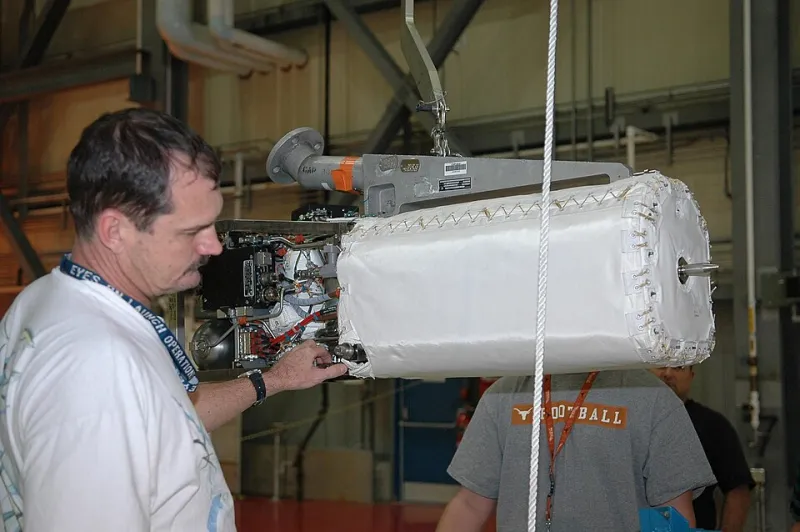
Photo: Kim Shiflett, Public domain, via Wikimedia Commons
Procurement cases for hydrogen HGVs are usually built on a tidy triangle: duty cycle, refuelling access, cost per kilometre. What sits outside that triangle, almost without exception, is the question of what happens when the vehicle leaves the fleet. For diesel it was never a pressing concern, because a mature market priced the answer daily. For hydrogen it is the question nobody put in the board paper, and it is now beginning to surface as the earliest UK demonstrator vehicles approach the end of their first operational lives.
That is not a technical failure. It is an accounting and assurance gap, and it has a habit of travelling back up the supply chain to land on the depot that bought the truck.
The disposal curve arrives before the depreciation curve
A finance director modelling a hydrogen tractor unit will typically assume a residual assumption borrowed from diesel or, at a push, from battery-electric. Both are weak analogies. A used diesel HGV has a deep pool of buyers, a well-understood inspection regime and a scrap value that anchors the downside. A used battery-electric truck has a growing, if thin, secondary market and an increasingly legible story about pack health.
A used hydrogen truck has neither depth nor consensus. The buyer pool is small, the inspection regime is specialised, and there is no established convention for translating stack hours into a price. In practice, that means the residual assumption is doing two jobs at once: it supports the finance case and it silently absorbs every uncertainty the operator has not documented. When the assumption is challenged, the whole case is challenged.
Operators in the North East and around the M4 corridor who took early vehicles on three- to five-year terms are now discovering this in real time. The trucks have performed. The paperwork has not kept pace.
Tanks: the evidence outlives the vehicle
Hydrogen storage on a commercial vehicle is a pressure system, and pressure systems carry a paper trail that does not simply transfer with the keys. Periodic inspection intervals are set by the receptacle standard and by the wider regulatory framework covering pressure equipment and the carriage of dangerous goods. Different cylinder designs carry different regimes, and the interval applied to a given vehicle depends on what was actually fitted — not on what the brochure said.
For a prospective buyer, the first question is therefore prosaic: what is the inspection status of each receptacle, and when is the next examination due? A tank with two years of certified life remaining is a different commercial proposition from one with eight months. If the operator cannot answer within a day, the buyer will price the uncertainty in, usually generously.
There is a second layer. Cylinders are damaged by misuse more often than by design. Overheating during a fast fill, contamination at the nozzle, an unreported impact in the yard — each leaves a trace in the maintenance record or, more worryingly, does not. A depot that logged every fill event, every fault code and every thermal anomaly has an asset. A depot that logged invoices has a negotiation.
Stacks: degradation that can be priced, and degradation that cannot
Fuel-cell stack health is the least standardised element of the whole picture. There is no UK-wide equivalent of a battery state-of-health certificate that a haulier, an insurer and a remarketing agent will all accept on sight. Stack degradation is real, measurable in laboratory conditions and considerably harder to measure in a yard on a wet Tuesday in Teesside.
What a buyer can work with is a duty-cycle record: hours run, load profile, number of start-stop cycles, coolant chemistry and history of any cell-level intervention. Stack life is driven as much by cycling and thermal management as by total hours. Two vehicles with identical odometer readings can present entirely different remaining lives.
The practical implication is uncomfortable but straightforward. If the operator cannot demonstrate how the vehicle was used, the buyer has no basis for a price and will default to the worst case. Documentation is not administrative garnish; it is the mechanism by which a second-hand market discovers value.
Warranties do not always travel
Commercial vehicle warranties in this segment are frequently written for the first owner, tied to a service regime performed by approved agents, and conditional on specified operating envelopes. Transferability varies by manufacturer and by contract, and the variation is rarely obvious from the headline terms.
Before a vehicle is even ordered, the fleet team should be able to answer three questions in writing: does the warranty transfer to a subsequent owner, what evidence is required to preserve it, and what voids it? A warranty that lapses on transfer does not merely reduce the resale price — it removes the buyer's principal protection against the one failure mode they cannot inspect.
Where transfer is permitted, the approved-service condition becomes a documentation obligation. A vehicle maintained outside the network may be perfectly sound and commercially unsaleable at the same time.
What the buyer will actually ask
Strip away the technical vocabulary and a second-hand hydrogen buyer in the UK is asking four questions.
- What is the certified condition of the storage system, and when does it next fall due?
- What is the evidence of stack condition, and who produced it?
- What protections survive the change of owner?
- Who can service this vehicle within reach of my depot, and at what lead time?
That final question deserves more weight than it usually receives. A vehicle is only worth what a buyer can operate, and the UK's hydrogen service network remains concentrated. A truck sold into a region without trained technicians is a truck with a discount attached.
A habit worth starting now
None of this requires new regulation or a new industry body. It requires depots to treat documentation as part of the asset rather than as a by-product of it. A residual-value file assembled at first registration — receptacle certifications and inspection dates, stack telemetry summaries, warranty terms and transfer conditions, a full service and fault history, and a record of the duty cycle the vehicle actually performed — costs little to compile and compounds in value every year.
The alternative is what many early adopters now face: technically sound vehicles, credible operating results, and no defensible answer to the only question the next buyer will ask. Residual value is not a concern for the end of a contract. It is a design constraint at the start of one, and in the UK's hydrogen freight market it is already shaping which trucks get ordered.