Beyond the IP Rating: Corrosion Planning for UK Port Power Infrastructure
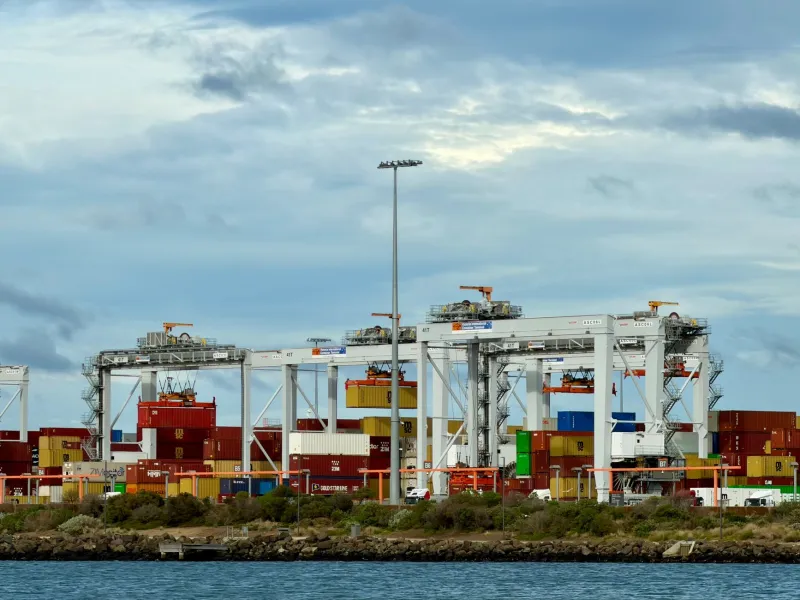
Port electrification is usually debated in megawatts and connection dates. The quieter question, and often the more expensive one, is what the equipment will be standing in. A quayside in Immingham, a ro-ro berth in Portsmouth and a marshalling yard in Aberdeen share an atmosphere that inland depots never see: airborne chloride, wet-dry cycling, condensation that forms inside cabinets as readily as out, and a working life measured against a marine environment rather than a motorway service area.
As UK ports commit capital to charge points, shore-power converters, hydrogen cabinets and methanol fuel-cell systems, corrosion deserves a line in the business case rather than a note in the operator manual.
The port estate is not one environment
The first mistake is to treat "coastal" as a single condition. Corrosivity classification under BS EN ISO 9223 places many UK coastal locations in categories C4 or C5, with splash zones and exposed offshore-facing structures pushing towards CX. But the boundaries are local, not regional. A cabinet set back behind a warehouse and screened from the prevailing south-westerlies may perform materially better than one on an open berth two hundred metres away, even though both sit on the same estate.
Practical site assessment therefore looks at four variables rather than a postcode:
- Distance and orientation to the high-water mark, combined with prevailing wind direction.
- Shelter, including the wake turbulence created by large buildings and container stacks, which can deposit salt in unexpected corners.
- Splash and spray exposure, particularly on berths handling ro-ro traffic, where vehicle movement and wash-down add to natural tidal spray.
- Local sources, from salt marsh and mudflat dust to de-icing salt applied to terminal roads in winter.
A useful discipline is to zone the estate before specifying anything: berth line, container yard, railhead, tank farm and admin perimeter will each justify a different enclosure grade and a different inspection frequency.
What an IP rating actually promises
Ingress protection ratings describe resistance to dust and water under defined test conditions. They say nothing about chloride attack, and a high second digit can generate false confidence. A cabinet rated for powerful water jets may still corrode at its hinges, its fasteners and the cut edges of its own sheet steel.
Salt-fog testing to ISO 9227 is a screening tool, not a service-life forecast. Continuous fog bears little resemblance to the wet-dry cycling of a real quayside, in which deposits concentrate as moisture evaporates and coatings are asked to do far more work. Operators are better served by asking suppliers for the coating system standard (ISO 12944 category, surface preparation grade and dry film thickness), the enclosure base material and the grade of every fastener, rather than a single hour count from a laboratory.
Four specification decisions that set the decade
Enclosure material and finish. Painted mild steel can perform respectably if the coating system is genuinely marine-grade and the cut edges are dressed and sealed; it will not if the specification defaults to a standard industrial finish. GRP avoids rust but brings its own considerations around UV chalking and fitting attachment. Stainless steel is not a universal answer either, since the wrong grade or poor passivation invites crevice corrosion beneath salt deposits.
Hardware and fixings. A4-grade stainless fasteners, isolating washers where dissimilar metals meet, and attention to the aluminium-to-steel interfaces that quietly drive galvanic corrosion. Gaskets and door seals should be specified by material, not simply by colour.
Climate control inside the cabinet. Condensation is frequently the more damaging mechanism than direct water entry. Sealed enclosures with heater elements, pressure-compensating breathers or closed-loop cooling manage dew point; unfiltered ventilation simply pipes chloride-laden air across the busbars. Intermittent duty cycles worsen the problem, because equipment that is not running does not self-heat.
Cable entry and drainage. Bottom entry with a drip loop, correctly sized sealing glands and cable ladder in a suitable material. Cables themselves degrade: sheathing hardens and cracks, and salt finds its way along the conductor path long before an insulation test fails.
Designing for the maintenance you will actually perform
Corrosion planning is only credible when it is matched to a realistic regime. A port that intends to inspect annually should specify equipment that can be inspected annually without scaffolding and a permit-to-work queue.
A workable structure is quarterly visual checks on seals, hinges and plinths; half-yearly fastener torque and gland inspection; and an annual condition survey recording coating breakdown against the ISO 4628 rust and blistering scales. Ultrasonic wall-thickness readings on mounting plinths and structural steel, plus sacrificial anodes where immersed steel is present, give an objective trend rather than an opinion.
Coupons are an underused tool. Mounting small test plates of the same material and finish alongside the equipment allows the corrosion rate to be measured directly, and provides evidence if a warranty claim is later disputed. Photography with a fixed reference and date is equally useful.
Coating touch-up should be planned, not treated as failure. For a C5 environment, a mid-life intervention on a painted enclosure is a normal expectation rather than a defect.
The warranty conversation worth having early
Corrosion claims are frequently lost at the exclusions stage. Problems often arise where the OEM's service plan assumes an inland duty cycle, or where "harsh environment" and "failure to maintain in accordance with instructions" sit in the small print without a defined exposure class.
The remedy is contractual precision. State the anticipated corrosivity category in the specification. Ask for a corrosion-specific clause separate from the general warranty, with a defined inspection record as the trigger for a claim. Confirm at handover that touch-up materials and a recommended spares list are supplied. A spare cabinet door and a set of seals cost little; a three-week wait for a proprietary assembly during a bank holiday costs considerably more.
Budget mechanics
Corrosion rarely appears as a headline cost. It arrives as unplanned downtime, as an RCD tripping mid-shift, as a charger that has to be isolated while a seal is replaced. A working assumption applied informally by many port engineers is that inspection, coating repair and small-component replacement will absorb a low single-digit percentage of the original cabinet cost each year in a C5 setting, against a much smaller fraction inland. It is indicative rather than universal, but it is the kind of line that should appear in the whole-life cost model rather than be discovered in year four.
Where hydrogen and shore power add complexity
Electrolysers, methanol fuel-cell cabinets and shore-power converters bring their own vulnerabilities. Rectifiers and air-cooled stacks draw large volumes of air through filters that must be specified with salt arrestance in mind, not just particulate capture. Water treatment and vent systems introduce new materials and new joints. Shore-power cables and connectors are handled by people, so mechanical damage and abrasion join the list of mechanisms.
The common thread is that air quality is an input to performance. A hydrogen cabinet breathing a chloride-heavy atmosphere is not the same asset as its datasheet describes.
A short pre-order checklist
- Record the corrosivity zone for each installation position, not for the port as a whole.
- Specify enclosure material, coating system and fastener grade explicitly in the tender.
- Require a condensation management strategy and state the duty cycle it assumes.
- Agree inspection intervals, record formats and the evidence route for warranty claims.
- Budget for touch-up, seals, filters and an annual condition survey from day one.
- Install corrosion coupons and keep the photographs.
The cheapest cabinet is not the one with the lowest quotation. In a marine environment, it is the one specified for the site it will actually stand on.