Before the First Purge: A Nitrogen Readiness Plan for UK Hydrogen Sites
Hydrogen project teams are accustomed to scrutinising the electrolyser stack, the compressor package and the grid connection. Nitrogen rarely receives the same attention. It is neither the product nor the primary fuel, so it tends to sit outside the headline capital cost until commissioning approaches. At that point, a site can discover that a utility assumed to be simple is actually a schedule-critical supply chain with its own purity grades, peak flows, storage losses and contractual commitments.
For UK hydrogen projects, nitrogen deserves to be planned as a safety and quality utility from the outset. It is used to displace air and hydrogen before maintenance, to protect equipment from moisture and oxygen, to support leak detection and to blanket liquids or vessels where contact with air is undesirable. None of these duties is glamorous, but each can stop a commissioning sequence. The practical question is not whether nitrogen will be needed, but when, at what flow rate, at what purity and through which supply mode.
Where Nitrogen Enters the Project
The first step is to map every nitrogen consumer, including those that appear only during commissioning. Pipework and vessel purging is usually the largest early demand: repeated cycles of pressurisation and venting can absorb more gas than the operating team expects. Inerting follows, particularly where hydrogen is introduced into equipment that must first be brought below an oxygen threshold. Leak testing may use nitrogen as a pressure medium, either alone or alongside helium or hydrogen tracer methods. Blanketing may be required for storage vessels, sample systems or chemical inventories. Analyser purge, seal support and instrument impulse lines can add small but continuous draws that matter over a month of operation.
The mapping should distinguish between commissioning demand and steady-state demand. A site may use very little nitrogen once running, yet require a high peak flow for a few days before first hydrogen. That distinction determines whether bulk liquid storage is justified, whether cylinder packs can bridge the gap, or whether on-site generation should be sized for a narrow window rather than annual average consumption.
Demand Is Lumpy, Not Average
Nitrogen sizing often goes wrong because it is based on average consumption. Commissioning is not an average process. Purge cycles may be repeated across several trains, vessels or test packs. A single inerting event can draw a large volume in a short period, and maintenance outages can create similar peaks later in the asset life. If the supply arrangement is sized for steady-state demand, the site may run short precisely when the schedule is least tolerant of delay.
A useful approach is to build a simple demand profile by day and by hour across the commissioning window. Identify the largest single event, the number of simultaneous consumers and the minimum pressure required at the farthest point of use. Then add a realistic margin for repeated purges and for the possibility that a test must be rerun. The profile should also account for future expansion: a site designed for one production train may later add a second, and nitrogen headers are easier to upsize on paper than after commissioning.
Purity Is a Specification, Not a Commodity
Nitrogen is often described as if it were a single product. In practice, purity grade, oxygen content, moisture content and particulate limits all affect suitability. A grade that is acceptable for general inerting may be unsuitable where low oxygen and low moisture are required to protect a stack, catalyst or sensitive instrument. Conversely, over-specifying purity across the whole site can add cost and constrain supply without improving safety.
The sensible route is a grade matrix: list each consumer, the required purity, the allowable moisture and oxygen levels, and the consequence of a shortfall. Confirm the requirements with the equipment supplier and the gas supplier rather than relying on generic assumptions. Where hydrogen quality standards apply, nitrogen used in purging or blanketing should be assessed for its contribution to contamination, not treated as a neutral background gas. The matrix also helps during audits, because it shows that purity decisions were made deliberately rather than inherited from a template.
Bulk Liquid, Cylinder Packs or On-Site Generation
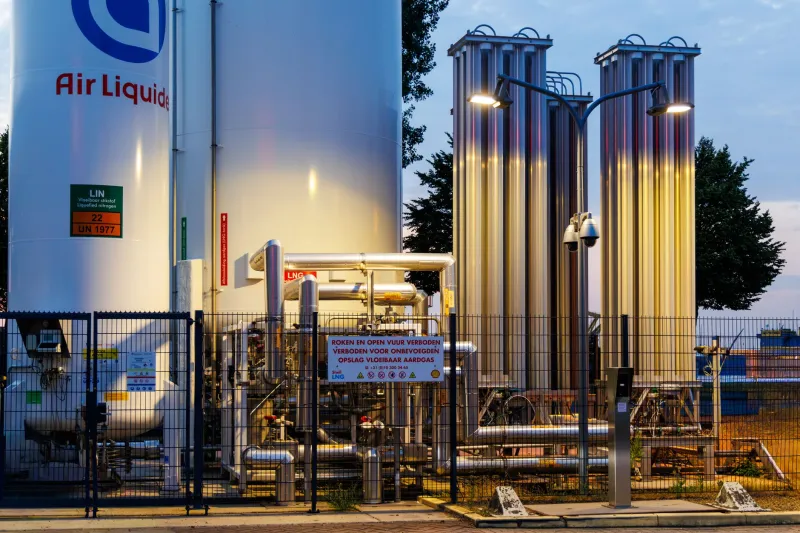
Bulk liquid nitrogen offers high volume and high flow in a compact footprint, which suits sites with significant commissioning peaks or continuous blanketing demand. The trade-offs are familiar: tanker access, storage tank siting, pressure control and boil-off. Boil-off is not merely a cost line; it is a supply-planning issue. A tank that is oversized for steady-state demand can lose product while waiting for the next commissioning campaign. Telemetry and a realistic delivery schedule matter as much as tank capacity.
Cylinder packs reduce capital expenditure and can be commissioned quickly, but they bring handling, manifold capacity and residual-return issues. They can work well for small sites, isolated consumers or backup supply, yet repeated changeovers during a heavy purge campaign can become a labour and safety burden. On-site generation, typically via pressure-swing adsorption or membrane separation, avoids regular deliveries and can provide a continuous supply, but it depends on compressed air quality, power, maintenance and the achievable purity. It is rarely a like-for-like substitute for high-purity liquid supply across every duty.
Many UK sites will end up with a hybrid arrangement: a bulk or generated supply for the main demand and cylinder packs for remote points, backup or specialist purity. The important point is that the choice follows the demand profile and grade matrix, not a single headline price per cubic metre.
The Contract Questions
Nitrogen contracts should be read with the same care as fuel or power agreements. Minimum take volumes, delivery windows, demurrage, equipment rental, telemetry, emergency response and returnable container charges can all affect the real cost. A supplier may offer a competitive unit rate but require a long notice period for changes, which is awkward when a commissioning date slips. Sites should confirm who owns the tank and manifold, who monitors level and pressure, and how an out-of-hours shortage will be handled. For projects in industrial clusters, shared supply or neighbouring user arrangements may be possible, but they need clear responsibility and metering.
A Pre-Commissioning Checklist
Before the first purge, the project team should be able to answer the following:
- Every nitrogen consumer is mapped, including commissioning-only users and future expansion.
- Peak flow, pressure and duration are calculated for the largest credible event, not annual average demand.
- A purity and moisture matrix is agreed with equipment suppliers and the gas supplier.
- Boil-off, tank size and delivery frequency have been modelled together.
- Vehicle access, tanker parking, manifold location and emergency isolation have been reviewed.
- Metering and telemetry are installed before the first bulk delivery.
- Cylinder handling, storage and changeover procedures are included in site induction.
- A contingency supply route exists for delayed deliveries or failed on-site generation.
- Commissioning documentation records purge volumes, purity checks and hold points.
None of this is exotic engineering. It is the ordinary discipline of utility planning applied to a gas that is easy to overlook. Yet nitrogen sits close to the safety case and the quality case for a hydrogen site. A project that sizes it late may find itself choosing between a rushed supply arrangement and a slipped commissioning date. A project that sizes it early turns a hidden utility into a controlled one.
For UK hydrogen developers, the nitrogen bill is not simply a line in the operating budget. It is a test of whether the site has been planned as an integrated facility or as a collection of headline equipment. The earlier that test is taken, the less likely it is to be taken during commissioning.