Down the Drain and Into the Tank: The Case for Britain's Waste-Derived Bio-LNG
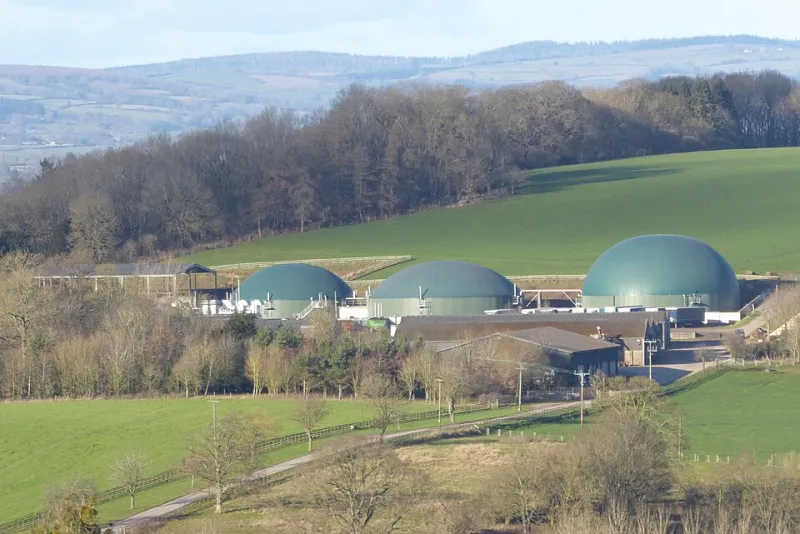
Photo: Philip Halling , CC BY-SA 2.0, via Wikimedia Commons
There is a stretch of works in the West Country where tankers fill up on fuel that was, a matter of weeks earlier, household sewage. It is not a clever demonstration project with a press officer attached. It is routine industrial chemistry, running to a schedule, producing a fuel that displaces diesel in heavy vehicles today.
That sentence ought to be the headline of Britain's transport decarbonisation effort. Instead, the attention and much of the public money continue to flow towards electrolysers, hydrogen valleys and megaprojects whose commercial operation remains, in most cases, some years away. This is not an argument against hydrogen research. It is an argument about sequencing, and about the cost of ignoring a technology that already works.
The unglamorous chemistry that already works
Anaerobic digestion is not new. Bacteria break down organic matter in the absence of oxygen, producing biogas that is roughly 60 per cent methane and 40 per cent carbon dioxide, together with a digestate that returns to farmland as fertiliser. Upgrade the biogas \u2014 strip out the carbon dioxide, which can itself be sold as a food-grade product \u2014 and what remains is biomethane, functionally indistinguishable in a boiler or a compression-ignition engine from natural gas.
The UK has built a substantial estate of these plants. More than a hundred sites now inject upgraded biogas into the gas distribution network, and water companies have folded sludge digestion into their treatment strategies rather than treating it as an afterthought. Food waste collectors supply a second stream, sharpened by the workplace recycling rules introduced in England in 2025, which require businesses to separate food waste for collection. Every tonne diverted from landfill or incineration to a digester is a tonne of methane captured rather than vented.
For road freight, the output is bio-CNG and bio-LNG, dispensed at refuelling stations on trunk routes. The vehicles exist. The fuel exists. The carbon saving, typically cited at around 80 per cent against diesel on a well-to-wheel basis, is among the best available for a heavy truck that has to keep working tomorrow morning.
Why hydrogen keeps winning the spotlight
Hydrogen has a political quality that digestion lacks. It photographs well. It arrives with electrolyser factories, port clusters and international trade deals, and it carries the promise of industrial regeneration in places that have waited a long time for good news. None of that is trivial.
But a fuel that must be produced, compressed, distributed and dispensed through a network that does not yet exist is a harder sell to a haulier than a fuel that arrives through infrastructure already in the ground. The gas grid is the largest piece of energy infrastructure Britain owns. Using it to move renewable carbon is the least fashionable idea in the sector, and quite possibly the most useful.
Honest limits, honestly stated
It would be dishonest to pretend that waste-derived gas can fuel the entire HGV fleet. It cannot. The feedstock is bounded by the number of people who flush, the amount of food that is thrown away and the tonnage of crops that fail to reach a shelf. Even with every realistic plant built, biomethane would cover a single-digit percentage of UK heavy goods vehicle energy demand.
That is not a weakness in the argument; it is the argument. A single-digit share of a very large number is a meaningful volume of diesel displaced, at a lower cost per tonne of carbon abated than most alternatives, using plant that can be consented and built in years rather than decades. The sector's mistake has been to let advocates oversell it, inviting the predictable rebuttal that it cannot do everything, and therefore does not matter.
Where it is genuinely held back
Three obstacles are commercial rather than chemical.
The first is policy continuity. The Green Gas Support Scheme closed to new applicants in 2025, and the design of its successor has been the subject of consultation rather than conclusion. No investor will commit capital to a plant with a fifteen-year asset life against a support mechanism with a two-year horizon.
The second is connection. New digestion plants face the same distribution network queue as any other generator or injector, and a gas grid entry agreement can be as elusive as an electricity one.
The third is traceability. The value of bio-LNG rests on its provenance, and the market still contains operators who are vague about feedstock origin. Under the Renewable Transport Fuel Obligation, waste-derived material earns double the certificates of crop-based fuel, and that premium is worth defending rigorously. Loose certification undermines the whole category.
What should happen in 2026
Policymakers should do four things, none of them expensive.
Confirm a successor support mechanism for biomethane injection with a long enough investment horizon to be bankable. Align the biomethane action plan work begun in 2025 explicitly with freight decarbonisation, rather than treating it purely as a heat policy. Prioritise grid connection dates for waste-to-gas projects that demonstrably displace diesel. And tighten certification so that the double-counting premium under the RTFO rewards verified provenance and nothing else.
What fleet managers should do now
Operators should stop treating gas as a transitional curiosity and model it properly. For return-to-base fleets and fixed trunk routes, bio-CNG and bio-LNG frequently beat both diesel and battery-electric on whole-life cost once payload duty is accounted for. The refuelling network is concentrated but usable, and dedicated on-site dispensing is a realistic option for larger depots.
The critical procurement step is contractual. Ask the supplier for feedstock classification, chain-of-custody records and a stated greenhouse gas saving, and write those figures into the agreement. Where the fuel is genuinely waste-derived, the operator is buying one of the strongest carbon stories available in road transport. Where it is not, the story collapses at the first audit.
The breakthrough Britain needs is already running, quietly, at the end of a drain. It deserves better than to be treated as the unglamorous alternative to the real story.
